
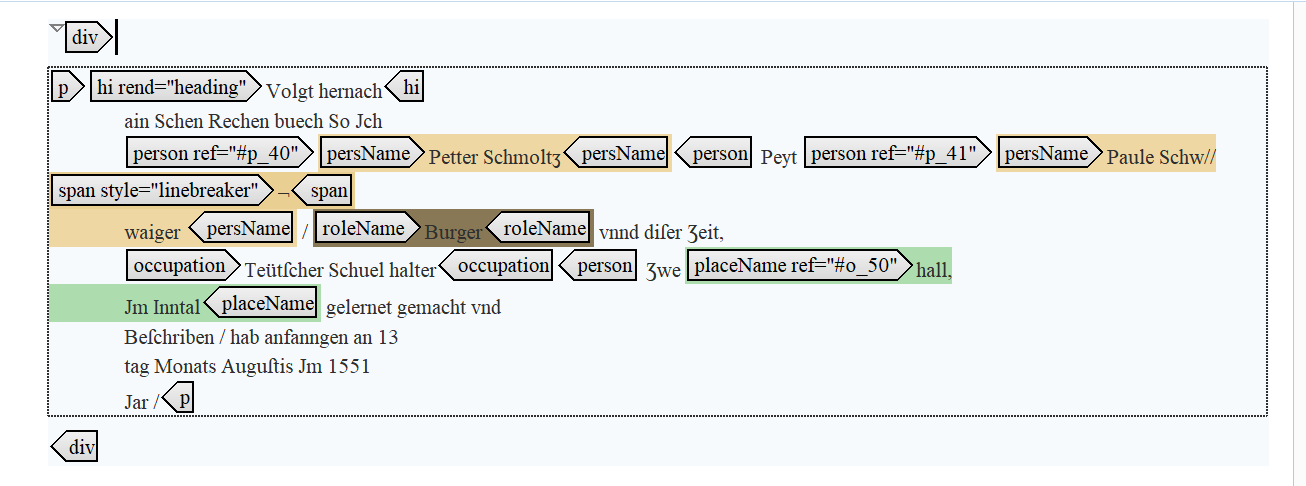
If we divide the publication of a digital edition of the handwritten German-language arithmetic texts from the 15th and 16th centuries into several stages, the transcription of the texts represents the first step. It undoubtedly forms the foundation of the edition, however, on its own, it is not sufficient: It is only through tagging that the digital edition is able to unfold its full potential.
These annotations make the edition significantly more searchable for us, fellow researchers and other users alike, and thus enable the sources to be explored systematically according to individual research questions.
An essential guide to the process of tagging could read a little like the following: The transcriptions, completed after 2 ½ years of project work, are first exported from Transkribus into the TEI-XML format, as an annotation of the texts has to be carried out within this format. The first step to annotating involves marking up the basic structure of the texts – thus making it possible to determine, for example, which chapters occur within a text, such as Numeratio, Divisio or examples of the Regula detri. At a more in-depth level, these individual sections of text are then also annotated with more detailed structural comments. Mathematical statements, explanations, calculation examples or proofs are thereby directly available for a specific search. In addition, the types of arithmetic examples are also identified. Users can therefore search specifically for sections dealing with methods such as the Regula Falsi or interest calculations. The structural annotation thus provides the foundation for a systematic exploration of the texts.
Afterwards, the focus shifts to the actual content: Among other things, raw materials, currencies, weights, volumes, as well as persons, cities, countries, and social roles – such as knights or maidens – are annotated. Mathematical operations and calculation methods are also marked up. In this way, the digital edition goes far beyond a mere reproduction of the text: It opens up an interdisciplinary approach to the sources and enables research questions from economic and social history, the history of mathematics, as well as German medieval studies and related philological disciplines.
By Norbert Hunor Orbán