By Franziska Putz
When taking an innovative approach to something that has never been done this way before, it is essential to have support. The same applies when working on a topic for a long time — a fresh perspective can always help to see things clearer.
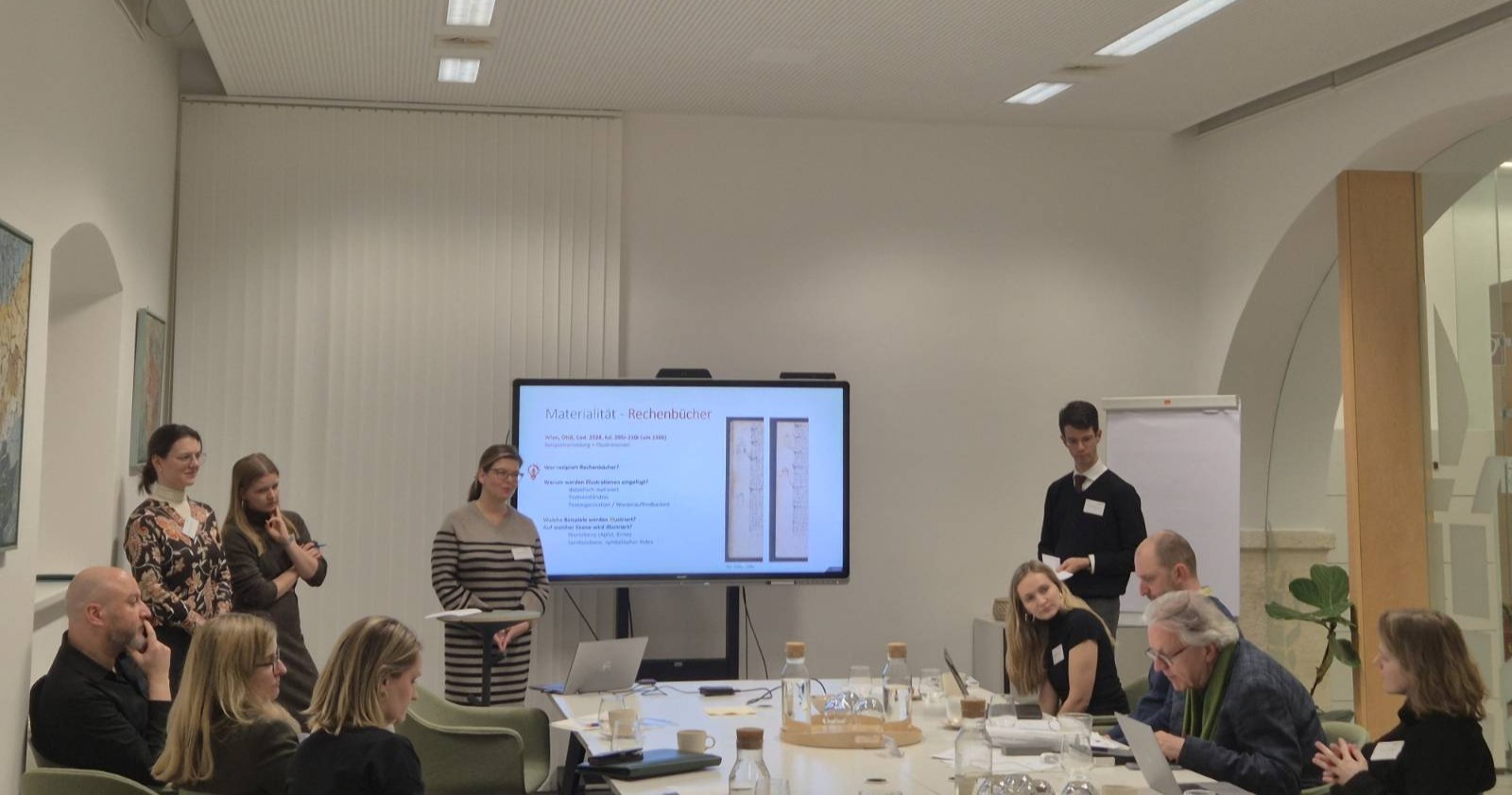
To gain new viewpoints on our project work and, as one could say, “get by with a little help from our friends”, we organised a workshop specifically adressing the narratological and philological issues regarding our reckoning books. We invited several German Philologists who are also working with narratology and narratological tools in various ways. The goal was to not only let them show us their own narratological work, but also to hear them apply their approaches to our corpus and work together to find new ways to deal with our texts.
The first day started with an introduction by Christina Jackel, head of the Klosterneuburg Abbey Library with which we officially collaborate, and a quick project overview delivered by our PI Michaela. Gregor and I then had the opportunity to present our dissertation projects and raise questions for which we hoped to receive new suggestions. This kept us busy until lunchtime.
After the break, we continued with the presentations of our guests and discussing their approaches: Over the course of the afternoon and the following morning, we explored a wide range of perspectives on mathematical and reckoning texts. We heard about short text forms and their structural proximity to the reckoning examples under discussion; about the presence of Jewish usury both within our reckoning books and in other media, where acts of calculation are used to support entirely different messages and about the materiality of these sources. We also examined the materiality of reckoning books — their layout, spatial structure, and physical design — and how these elements actively shape mathematical explanation. Further contributions examined the concept of “voice” as a narrating category in didactic works, pictures as organising paratext and the ways in which numbers can operate as structuring devices within a narrative or even generate narrative patterns of their own. Several papers had the consensual approch of numbers as narrative phenomena in their own right, demonstrating that enumerations, sequences, and itemisations can indeed form narrative structures.
Overall, we worked on diverse methodological approaches to pragmatic texts, showing how richly these materials can be interpreted through philological, narratological, and cultural lenses. And so, by the end of the workshop, it was even more clear than before that even though numbers may not lie (except of course in the Regula falsi), they certainly like to narrate.
Programme
28.11.2025
09:30–09:50: Workshop Opening & Welcome
Christina Jackel & Franziska Putz
09:50–10:30 Thematic introduction – ARITHMETIC
Michaela Wiesinger (Innsbruck)
10:30–11:00 Kaffeepause
11:00–11:45 Teilprojektvorstellungen
Gregor Kodym & Franziska Putz (Innsbruck)
12:00-13:30 Mittagessen im Stiftsrestaurant Leopold
13:30–14:10 Überlegungen zur Narratologie von Kurztexten des 16. und 17. Jahrhunderts
Matthias Meyer & Eva-Lotte Gebhardt (Wien)
14:10–14:50 Die Zahlen der Helden. Zur Narratologie des (Er-) Zählens im Prosalancelot
Juliane Mego (Wien)
14:50–15:20 Kaffeepause
15:20–16:00 Kotextualität als Interpretament. Mit einem Rechenrätsel beim lateinischen Alexander
Katja Weidner (Wien)
16:00–16:40 Materielle Narratologie – Schnittstellen zwischen Stoff und Story
Rabea Kohnen, Helene Eisl & Elisabeth König (Wien)
16:40–16:50 Abschluss 1. Tag
Michaela Wiesinger & Franziska Putz
29.11.2025
09:30-10:10 Das Narrativ des ›Judenwuchers‹ im Spiegel der Überlieferung von Textaufgaben
Kathrin Chlench-Priber (Bonn)
10:10-10:50 Das Land, in das die Zinsen fließen. Raumtheoretische Betrachtung des so genannten ‘Judenwuchers’ in BSB Cgm 4930
Matthias Däumer (Krems/Salzburg)
10:50-11:20 Kaffeepause
11:20-12:00 Wiederholung und Variation: Zahlen als Erzählstruktur im Friedrich von Schwaben
Lena Zudrell (Salzburg)
12:00-13:00 Abschlussdiskussion